Posts

Showing posts with the label tsundoku

More Game Design with Factors of 60 [Tsundoku]

Image
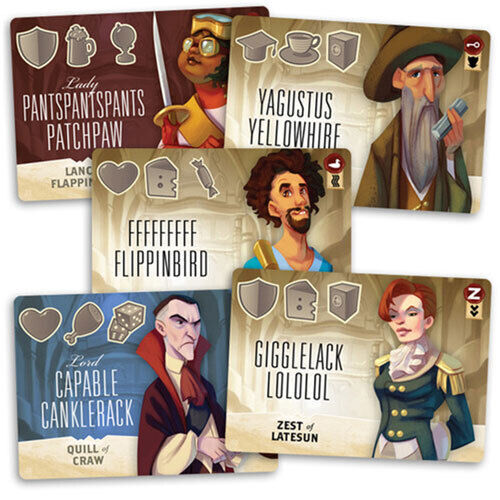
Building from my previous post about using factors of 60 as the basis of a set collection game, let's consider how the game might be played. To recap: TSUNDOKU is a game where you gather a bunch of books and try to read as many of them as possible. I have a long google doc I keep that documents various ways to acquire cards in a game. I keep this list as a source of inspiration when I just need to start somewhere in a new design.  I think I'll take a cue from Magic and consider the Winston Draft format. Under normal rules, the Winston draft works like this [ source ]:  All supplied products are put into one large stack and separated into smaller piles with one card each at the beginning. Usually four piles are used. These piles are face up and the cards in the pile are known. The first player must choose a pile. Then one card from the stack is added to each pile, meaning the chosen pile is now one card while all other piles are two cards. Players take turns taking piles in t...
Designing a Card Game with Factors of 60 [Game Design]

Image
I'm a big fan of designing around set collection mechanisms, but the trickiest of that design is starting with a balanced set of variables. You can use an existing familiar set like a deck of cards, or a PAIRS deck, or even a Mirror Deck . The problem is that if your initial baseline is too ordered and symmetrical, you'll get kind of boring endgame scoring.  For example, if apples, oranges, and pears are in equal quantity in a bag of chits, then any endgame scoring condition that favors one of those fruits doesn't feel unique to that fruit. If each fruit has some other attributes, like freshness, or sweetness, or rarity, then you start getting a little bit more grit in the gears. Now you've given players more factors to consider as they collect their fruits. Speaking of factors , I've always been a fan of the number 60 because it can be subdivided into 1, 2, 3, 4, 5, or 6. 1 × 60 2 × 30 3 × 20 4 × 15 5 × 12 6 × 10 I like to use this basic structure to create a deck ...